Is Healing an Intergenerational Project?
November 3, 2026
Kristen Jackson Banister
A personal reflection on the anger we inherit, the ways we learn to keep the peace, and the courage it takes to reclaim our capacity to stand our ground.
On anger, ancestry, and the courage to belong to ourselves
The Women Who Were Not Nice
On anger, ancestry, and the courage to belong to ourselves
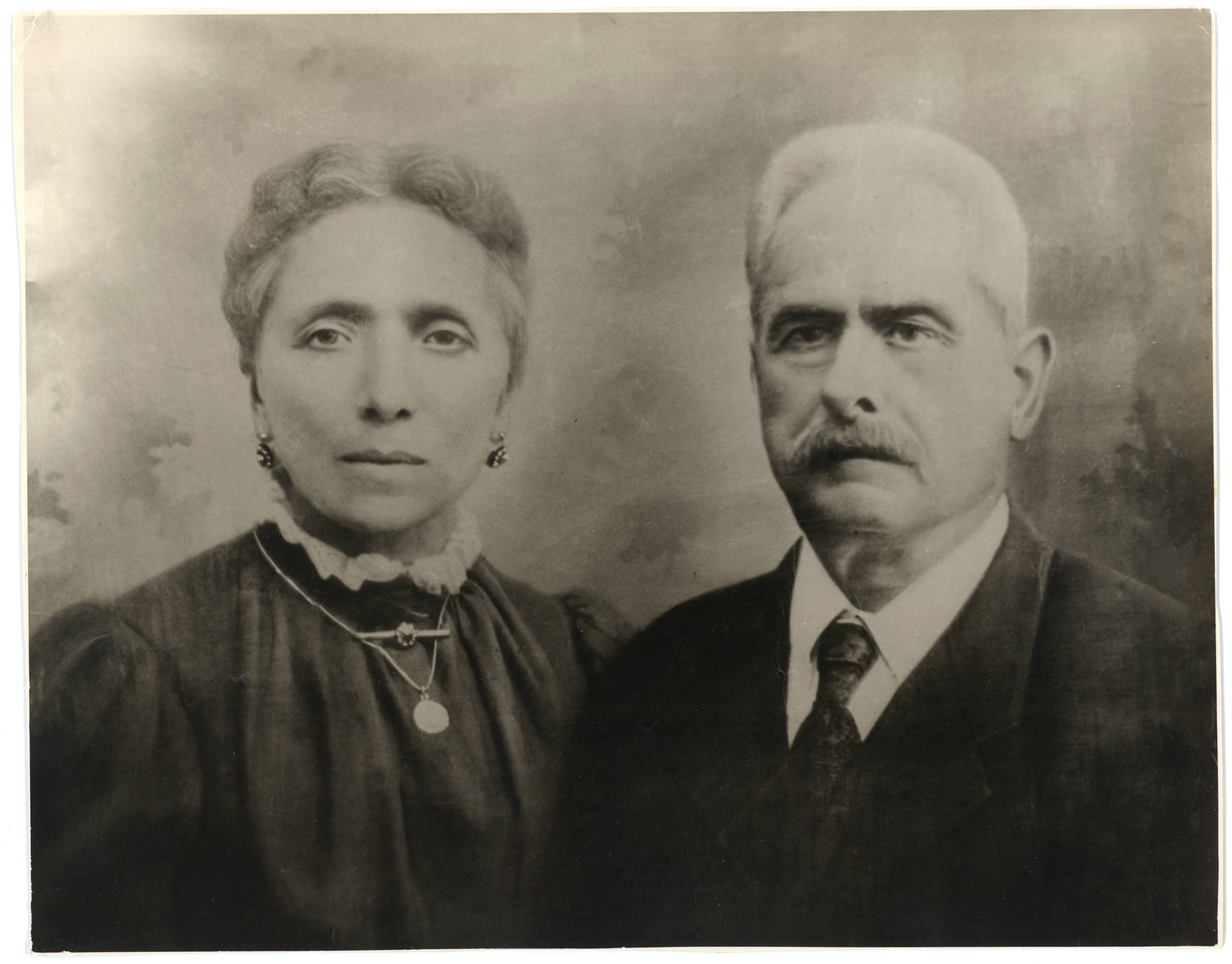
There's a photograph of my great-great-grandmother, Gustina Sciannameia, hanging on the wall in my house. She has a certain stillness in her eyes, dark skin, and high cheekbones. She stands beside her husband, Guito. He looks studied, serious, cerebral. She looks like someone who knows things about the earth, the plants, the movements of spirits.
Gustina lived most of her life in Bari, on the Adriatic coast of southern Italy. Near the end of her life, she crossed the Atlantic to the American Midwest, where she died. I believe she came so that one of her children could care for her. I know very little about what she thought of leaving her home, or what she made of the country where she spent her final years.
Gustina had been dead nearly eighty years by the time I was born. Her daughter, Theresa, had been dead fifty. Her granddaughter, Florence, was the woman who repeatedly told me to sit still and move my bangs out of my face. My grandmother.
I didn't have a doting, nurturing grandmother. There was tenderness in her, but she didn't lead with it. What she offered instead was a deadpan honesty about how to be accepted in this world.
I wonder how much of that she learned from her mother and grandmother. Was Gustina tough in her own way? I'll never know for certain. Of ocurse, I'll never have the know Guistina, but I carry her DNA and I have met her in a dream ... she was furious.
Her anger was a gale-force wind. She seethed at patriarchy, demanding that I free myself from the forces that constrained her life and the lives that came after her.
This wasn't about men and women. No matter our gender, she seemed to insist, we're caught in a way of thinking that keeps us trapped. A way of thinking that imagines human beings standing outside of nature, entitled to dominate and control it. Our own human nature, the nature of those we deem lesser than ourselves, and the living world to which we belong.
It's destroying life, she railed. Set yourself free.
But, oh, I sigh. An impossible demand, great-grandmother.
It's inside and out. It's identity and survival. It's woven into the ways we've learned to belong, the things we've learned not to say, the parts of ourselves we've learned to conceal.
Surely she knows this. It was already that way for her. Perhaps the trap has only tightened over the generations. Perhaps she's simply had enough. I’ve wondered whether Gustina can express her rage so freely because death has freed her from the boundaries of niceness.
I recently came across a book called Aradia, published in 1899, a strange and fascinating account of Italian witchcraft. In its pages, Diana, goddess of the moon, sends her daughter Aradia into the world to teach witchcraft to the oppressed. The witches call upon the forces of the earth, the moon, and their own will to challenge the power of those who rule over them.
Their prayers are unlike the prayers I grew up knowing. They praise their gods, make their requests, and then threaten the gods with punishment if their requests aren't granted.
And unless thou grantest this,
Mayest thou never know peace or bliss.
There is no meekness in these prayers. These witches aren't trying to be good. They are calling upon powers larger than themselves and insisting that those powers listen.
Of course, Aradia is a peculiar and contested book. I don't know how much of it describes actual practices and how much belongs to folklore or the imagination of its author. But something in it speaks to me. It touches a longing for a power that doesn't require permission.
I wonder if other generations have known that longing. How many have felt the heat of an objection rise in their bodies, only to swallow it? How many learned to smile when they wanted to scream? How many learned that the price of belonging was silence?
And how many refused?
When I was a child, my father's anger scared the bejeezus out of me. Anger was not safe. Self-assertion was even more unsafe. I learned something about the importance of being agreeable. About reading the room. About knowing when to disappear, when to acquiesce, when to keep my mouth shut.
These are useful skills when your safety depends upon them. But they come at a cost. There are ways of keeping the peace that require us to abandon ourselves. And after enough years, we may not even notice we've gone missing.
I've spent a good part of my adult life learning to reclaim my anger. Not the reactive, take-me-over anger that leaves damage in its wake. I'm interested in something else. I'm talking about planting my feet on this earth and allowing anger to be just as it is. Feeling the way it tightens my jaw, burns in my chest, gathers in my belly. Not pushing it away. Not throwing it at someone else. Staying.
Sometimes I imagine myself as big as the whole universe or as fierce as a fighting lioness. And sometimes, when I stay with the sensations of my anger, something shifts. The heat becomes strength. The urge to strike becomes the capacity to stand. Something that was tangled in fear becomes clear. Anger, when I can remain present to it, returns me to a part of myself I learned long ago to leave behind.
I think about Gustina and the life she lived, the choices available to her, the bargains she made with the world. What did she endure? What did she refuse? Did she ever feel the satisfaction of speaking something she'd been afraid to say? Did she know the force of her own anger? Or did it remain folded away inside her, tucked beneath the demands of marriage, family, religion, respectability, survival?
I don't know. The woman in the photograph isn't telling. But the woman in my dream has plenty to say. She is not interested in helping me become more agreeable.
She wants me free.
Perhaps freedom is an intergenerational project after all. Perhaps it happens in our own lives in small moments of refusal. In the willingness to disappoint someone. In saying what we mean, even when our voice trembles. In learning that we can belong to ourselves without withdrawing our love from the world.
When we are taught to suppress our anger, we may lose access to all of its expressions. And anger has many faces. It can be cruel, possessive, destructive. It can narrow our vision until we can no longer recognize the humanity of those who stand before us. But anger can also arise from our deepest capacity to care. It can move us to protect a child, stand beside someone who is suffering, or refuse to participate in something we know is wrong.
The question, perhaps, isn't whether we should be angry. It's whether we can remain awake to what we love while we are angry. Sometimes anger is mean and ugly. And sometimes anger is love with its feet planted firmly on the earth. It says: This matters. I matter. Enough.
The world needs this kind of anger.
I look at Gustina's photograph. More than a century separates us, and I cannot know what she would make of the life I live. But sometimes I like to imagine that when I stand my ground, when I say the difficult thing, when I refuse to make myself smaller for the comfort of others, some soft wind exhales through the generations.
And somewhere, my fierce great-great-grandmother is a little more satisfied.
For a moment, at least.
