Grounding Is a Practice of Belonging
Grounding is often described as a way to calm the nervous system. But perhaps there is something deeper happening when we turn our attention toward the earth.
Last month, on my way to teach, a rush of anxiety pulsed through my chest, accompanied by a welling of self-criticism.
I paused, slipped off my shoes, and put my bare feet on the earth until my senses registered the cool soil. My mind quieted. My muscles softened.
Time after time on the dance floor, I’ve heard some version of the same instruction:
Find your feet. Feel the ground. Know where you’re dancing.
Long ago, during a wilderness ceremony in the Inyos, I found myself alone and scared in the dark. My mentor had told me earlier that day what to do if fear came:
Press down. Find the earth. Root in, and rise from there.
Years of using the earth to steady myself—and yet it took a casual comment from someone in my office to stretch a thread between grounding and the ways life can break our hearts.
“I don’t feel so small,” she said, “when I imagine spreading my roots through the earth.”
Something clicked.
When we are hurt, frightened, or protecting ourselves from loss, our world can become very small. We can feel alone and isolated, cut off from other people and from life itself.
I have heard it said that all trauma happens in relationship. Though I’m not sure I would make the claim quite that simply, I think there’s something to it.
Call it trauma or suffering, some of our most painful human experiences seem to happen when we feel profoundly alone.
And this made me think differently about grounding.
Grounding as relationship
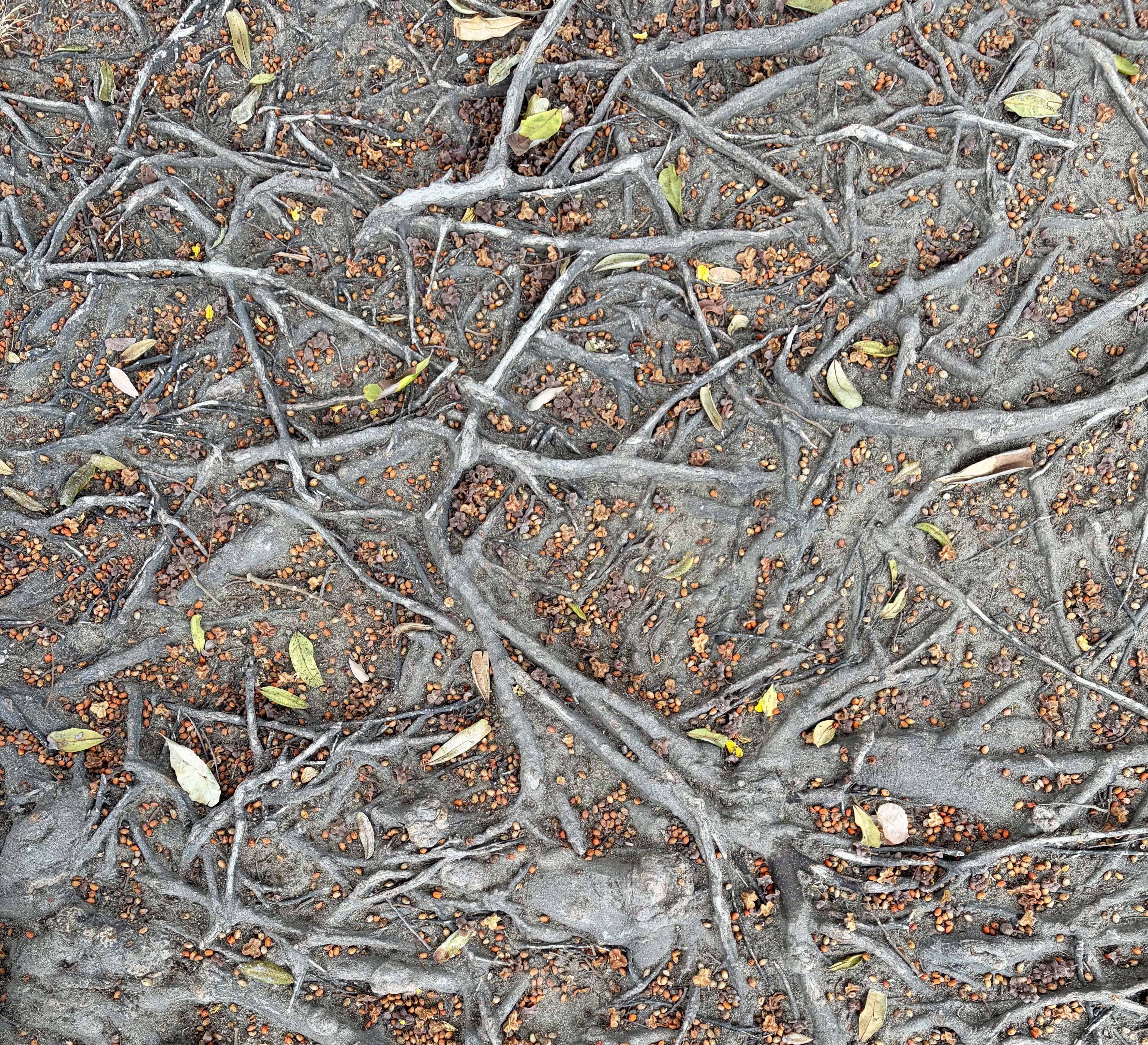
Grounding isn’t only about feeling our feet on the earth.
It is about recognizing our relationship to the earth.
The earth created us. She feeds us. She nurtures us. We belong here.
Of course, grounding invites us into presence: this moment, right now, my feet on the earth beneath me. But there is another layer beneath that one.
When we are grounded, we can feel that we are doing more than simply standing on the earth.
We are being held by her.
The earth reminds us that we belong to life itself.
And perhaps this is part of what makes grounding helpful. When I feel the support of the earth beneath me, there is an invitation to remember my place within something much larger than myself.
I am not the only one held here.
We all belong here.
Whatever I am feeling in this moment—grief, fear, loneliness, longing—I am not the only human being on this earth feeling it.
I am not alone.
The earth asks us not to leave
It can be so tempting, especially in spiritual practice, to take our attention upward. Toward expansiveness. Toward transcendence. Toward the heavens.
From time to time, someone in my office will ask me, “Why do I have to feel the earth? I like to feel the sky.”
I understand.
I have my own spiritual practice that often aims upward.
And yet, over years of doing this work, I have witnessed again and again that there is something about turning toward the earth that helps us find our way back from separation.
The earth asks us not to leave.
She asks us to inhabit our bodies. To claim our place in our own lives. To remember that we belong here.
Perhaps grounding, at its deepest, is not simply a technique for calming the nervous system.
Perhaps it is a practice of remembering relationship.
With the body.
With the earth.
With one another.
With life itself.